

In the exam room, the sentence I hear most often from Black women is some version of this: every doctor tells me nothing is wrong, but I know something is. They are right. Something is wrong. The problem is not their body. The problem is that much of what we were trained to look for was never described on skin like theirs.
A Medicine That Was Not Drawn for Everyone
Open almost any medical textbook and look at the pictures of skin conditions. For generations, those pictures have shown the condition on light skin. We teach students to look for redness, for a pink flush, for a bright, angry inflammation. But brown and black skin does not always turn red. The same inflammation can show up as a deeper brown, a dusky purple, a grey or ashen tone, or simply as skin that has grown thick and leathery. A clinician who has only ever seen the light-skin version can look directly at darker skin and genuinely not recognize what is in front of them.
This is not a small gap. It is why a growing movement in medicine, including resources like Mind the Gap, exists at all: to finally show what common conditions look like across the full range of skin tones. The lesson is simple. If you were trained on one kind of skin, you will miss things on another.
Now Bring That Below the Waist
If this is true for the skin on your arms and face, it is far more true for the vulva, because the vulva is barely taught at all, and almost never on darker skin.
Take lichen sclerosus, a chronic condition that causes itching, soreness, and thinning of the delicate skin of the vulva, and over time can lead to scarring. In the textbooks, it is described and pictured a certain way: classic porcelain-white patches, a shiny, parchment-thin look, bright inflammation. That description, and that expectation of what the skin should look like, came from decades of images taken mostly in white women.

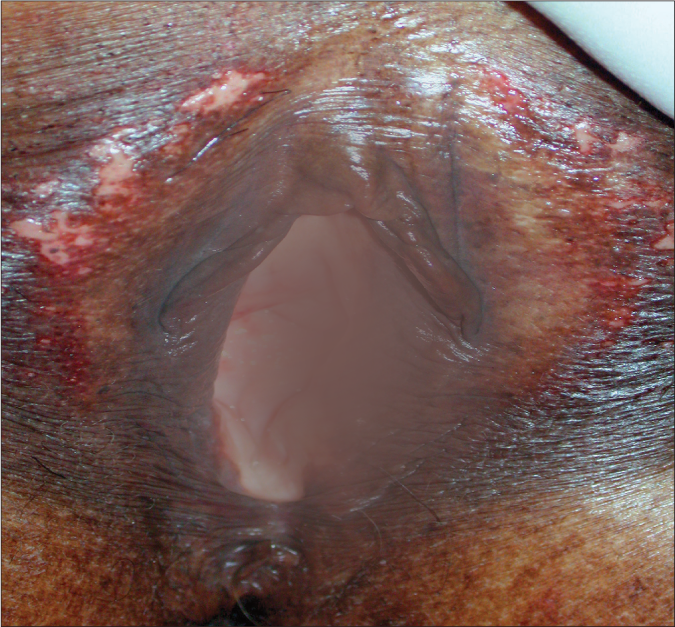
On darker skin, lichen sclerosus often does not look like that at all. The inflammation may not read as redness. Instead of porcelain-white, the affected skin can show up as darkening, called post-inflammatory hyperpigmentation, or as pale and lighter patches where the color has been lost, or as both at once. It can show up as thickening, where chronic irritation and scratching leave the skin tougher and leathery. It can show up as scarring, the same tendency that makes some black skin form keloids. There is even a known variant on darker skin that looks like loss of pigment and gets mistaken for vitiligo. So a woman can have the very same condition, and the very same pain, and still be told she does not meet the criteria, because the criteria were written for skin that behaves differently.
And Then It Becomes “In Your Head”
Here is the part that troubles me most. When the exam does not match the textbook, the next sentence a woman often hears is that the pain must be stress, or anxiety, or something left over from her past. For Black women, who are already less likely to be believed about their pain, this becomes a second injury laid on top of the first.
So let me say plainly what I tell my own patients. Pain is not a character flaw, and it is not imaginary. It has an origin. Vulvar pain usually has more than one, the skin, the nerves, and the pelvic floor muscles all play a part, and a careful clinician can work through them one at a time. What it is not is a sign that you are making it up.

What You Can Do
- Ask your clinician directly: have you looked at how this condition presents on darker skin? It is a fair question, and a good clinician will not be offended by it.
- Ask what is being tested and why. Ask them to tell you what they actually see, not only what they conclude.
- Bring a simple description of your pain: where it is, when it started, and what makes it better or worse. Your own observations are real data, and they matter.
- Keep going until someone takes you seriously. Being dismissed once, or five times, does not mean nothing is wrong.
Why the Foundation Is Working on This
One of the clearest gaps in medicine right now is something as basic as pictures. There are very few good, consented images of vulvar conditions on black and brown skin, which means the next generation of clinicians is being trained with the very same blind spot. Part of our work at the ZenNovid Foundation is to help close that gap, through education and through accurate illustration across the full range of skin tones, so that I have never seen it on skin like yours finally stops being a reason women go unheard.
If you are a Black woman who has been told, again and again, that nothing is wrong, I want you to hear this from a doctor. You are not imagining it. Your skin may simply be telling the story in a language your doctor was never taught to read. You deserve care that starts by believing you.
Denniz Zolnoun, MD